First, take a breath.
A locked jaw is frightening, but it is very rarely dangerous. In most cases the small cushioning disc inside the jaw joint has slipped forward and is blocking the hinge (a closed lock), or the hinge has slid past its ridge and the muscles have gone into spasm to hold it there (an open lock). Both are mechanical problems — and mechanical problems respond to skilled, hands-on physiotherapy.
Who should I see for a locked jaw?
A locked jaw is a mechanical problem of the temporomandibular joint (TMJ), so the right clinician is a specialist TMD physiotherapist. A&E and NHS 111 can check for a fracture or a dislocation after an injury, but they rarely provide the joint mobilisation, muscle release and rehabilitation that restore opening — and a hospital referral to a jaw clinic can take months. In London you can self-refer directly to Krina Panchal at The TMD Physio in Waterloo.
Closed lock or open lock — which one is yours?
Both are common, both are treatable. Knowing which you have tells us what to do first.
Closed lock
Jaw won't open fully
What's happening
The disc that cushions the joint has slipped forward and sits in the way of the hinge, so the jaw can rotate but cannot glide forward. Clinically this is an anterior disc displacement without reduction.
How it usually feels
- Opening limited to about 20–30 mm (two finger-widths)
- Jaw deviates towards the locked side
- Previous clicking has gone quiet
- Aching in front of the ear, worse with chewing
How Krina helps
Gentle joint distraction and mobilisation to free the hinge, intra-oral release of the masseter and pterygoid muscles guarding the joint, then a graded opening programme so the gains hold. Many patients leave the first session opening further than they arrived.
Open lock
Jaw stuck open or won't close
What's happening
The jaw hinge has slid forward past the bony ridge in front of it and the muscles have clamped down, holding it there. Clinically this is a TMJ subluxation (partial) or dislocation (complete).
How it usually feels
- Mouth stuck open after yawning, a dental visit, laughing or a wide bite
- Teeth cannot be brought together
- Muscle spasm and pain at the side of the face
- Repeat episodes become easier to trigger
How Krina helps
Call us straight away: if the jaw is still stuck open, Krina will tell you exactly what to do and arrange the quickest route to getting it back in place. Once it has reduced, treatment calms the spasm, restores controlled movement and builds the stability that stops it happening again.
Don't wait for it to 'settle'. Let's get it moving.
While you wait for your appointment
Simple things that calm the joint and the muscles around it — and a few that make a lock worse.
Do
- Eat soft food and cut it small — avoid anything that needs a wide bite (apples, baguettes, burgers).
- Rest the jaw: lips together, teeth slightly apart, tongue resting on the roof of the mouth.
- Warmth on the side of the face for 10–15 minutes, two or three times a day, to ease muscle guarding.
- Support your chin with a fist when you feel a yawn coming so the mouth doesn't open wide.
- Note how many finger-widths you can open each morning — Krina will use this at your assessment.
Avoid
- Don't repeatedly force or test the lock — it inflames the joint and tightens the muscles further.
- Avoid chewing gum, nail biting and long dental appointments until you've been assessed.
- Don't wait weeks for it to 'sort itself out': the sooner a closed lock is treated, the easier it is to restore opening.
Why A&E and 111 so often can't help — and who can
Emergency services are brilliant at ruling out fractures and relocating a jaw that has fully dislocated after an injury. But a lock without trauma is a musculoskeletal problem, and that is not what A&E is set up to treat.
A&E or NHS 111
- Hours in a waiting room, often to be told it isn't an emergency
- Painkillers and advice to 'see your dentist or GP'
- Onward referral to a hospital jaw clinic can take months
- No hands-on treatment of the joint or the muscles
The TMD Physio, Waterloo
- Self-refer — no GP or dentist letter needed
- 55-minute assessment with a specialist TMD physiotherapist
- Hands-on treatment begins in the first session
- A clear plan, a home programme and liaison with your dentist or consultant if needed
What happens when you book
Tell us it's a lock
Book online or call. Mention that your jaw is locked and we'll prioritise the earliest slot — and tell you what to do in the meantime.
A proper assessment
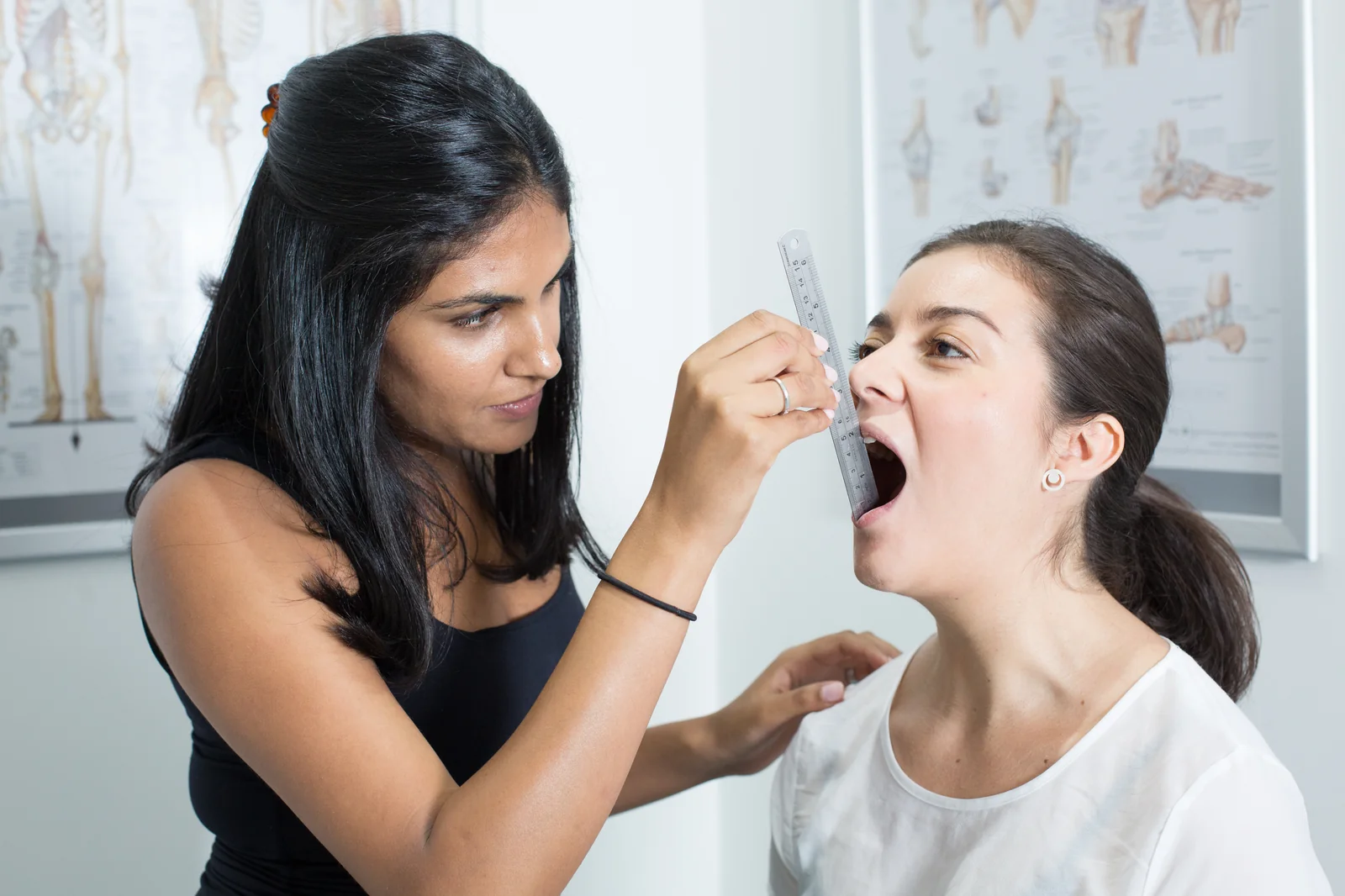
Krina measures your opening, checks how the joint moves and feels, examines the muscles inside and outside the mouth and screens the neck — the whole picture in 55 minutes.
Treatment on day one
Joint mobilisation and muscle release start in the same visit. Most patients notice a change in movement before they leave.
Your plan
A short, honest plan: how many sessions, what you'll do at home and when to expect normal function. Follow-ups are 25 minutes from £95.40.
See the research
What the published research says about jaw locking and TMD
14 studies in our Evidence Library, graded at their true strength — including the ones that don’t favour a treatment.
- Manual therapySupported by guidelines6 studies
- Jaw exerciseModerate-certainty evidence8 studies
- Guidelines & diagnosisSupported by guidelines4 studies
Key studies
- Management of painful Temporomandibular disorder in adults
This UK guideline for adults with painful temporomandibular disorders, which affect the jaw joint and surrounding muscles, combines research with expert agreement. It supports education, self-management, exercise, selected hands-on therapies and cognitive behavioural approaches, a form of talking therapy, particularly for pain lasting at least three months. It also explains referral pathways and the roles of primary and specialist care.
- Management of chronic pain associated with temporomandibular disorders: a clinical practice guideline
An international guideline on jaw pain lasting at least three months strongly recommends therapist-assisted joint movements and hands-on treatment of tender muscle points compared with dummy treatments. It gives a weaker, conditional recommendation for manipulation, another hands-on joint technique. It also conditionally recommends against several treatments, including low-level laser therapy and removable bite splints.
- Management of chronic pain secondary to temporomandibular disorders: a systematic review and network meta-analysis of randomised trials
This analysis included 153 trials involving 8713 people with long-standing jaw pain. Participants were allocated to treatments by chance. Therapist-assisted jaw movements and hands-on treatment of tender muscle points probably improved pain compared with dummy treatments.
Locked jaw — your questions
Straight answers to what patients ask us when their jaw has locked.